After Greene resigned as Quartermaster he was on the military court in which convicted John Andre, who had been a spy along with Benedict Arnold in September of 1780 (Logan, 2009). After Benedict Arnold had been exposed as a spy, Greene took his place as Commander of West Point in New York (Carborne, 2008, p. 143). Greene only stayed at West Point for a very brief period of time, for the American armies in the Southern states were losing and a new Southern commander was needed. George Washington chose Nathanael Greene to be the new Southern Commander in 1780 (Carborne, 2008, p. 144).
Greene arrived in Charlotte, NC on December, 2, 1780. Greene was surprised at how weak American army in the South was under former commander Horatio Gates. In the Southern troop in which Greene took over only 800 of the 2, 307 men were fit for duty, and had proper clothes. Greene and Gates did not like each other, but when they met they were civil because Gates appeared like such a beaten man, which caused Greene to take pity on him (Carborne, 2008, p. 154). Nevertheless, Greene needed to effectively make decisions about his troops, for his rival British General Cornwallis had four thousand men with the best training and equipment (Carborne, 2008, p. 156).
Greene’s first decision as Southern Commander was to move the troops away from the camp Horatio Gates had them in because the conditions were terrible (Carborne, 2008, p. 157). Greene decided to divide his troops into two groups. Greene place 600 of his best troops with Daniel Morgan to go to the Catawba Valley, which was 100 miles from Charlotte (Carborne, 2008, p. 157). The rest of Greene’s army went to set up camp on the Pee-Dee River on the hills of the Piedmont in North Carolina (Carborne, 2008, p. 159). Greene’s strategy to separate his army was to maximize the limited resources of the land, while at the same time be able to keep the units close enough to communicate with each other (Logan, 2009). A second was for Cornwallis to confront Greene’s best troops separately, since Greene considered many of his troops to be inferior (Carborne, 157, p. 157). The troop separation proved to be effective for Morgan’s division had managed to make General Cornwallis 86 percent of his troops, who fought in the Battle of Cowpens on July, 17, 1781. When the officers in Greene’s camp heard the news along with Greene they celebrated with an alcoholic beverage called cherry bounce (Carborne, 2008, p. 166-167). Greene’s were not able to celebrate for long, for Cornwallis in anger arranged 2, 500 troops to come fight Morgan, and Cornwallis.
Greene did not panic, but remained completely under control at the news in which Cornwallis was after him (Carborne, 2008, p. 170). Greene decided to unite the troops at Guilford Courthouse (Carborne, 2008, p. 170-173). Guilford Courthouse was a tiny village in
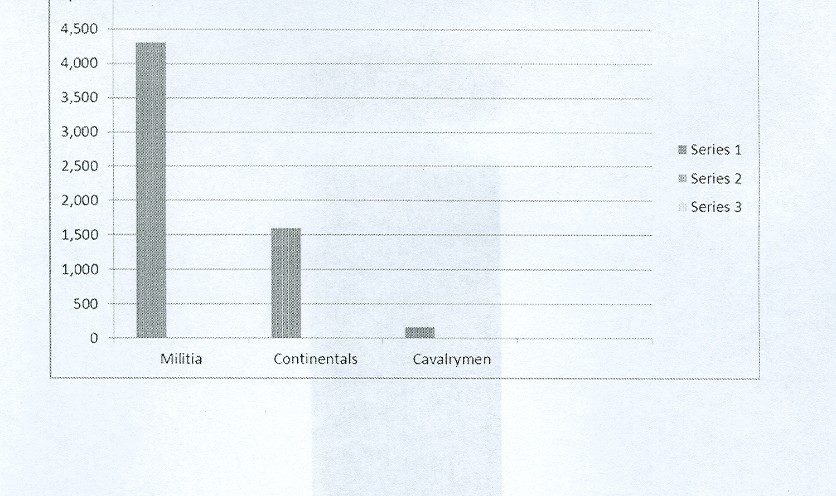
On March, 14, 1781 Greene had reached Guilford Courthouse. Greene had acquired a wide collection of troops from
The Battle of Guilford Courthouse happened with the beginning sounds of fifes, pipes, and snare drums. The sound of the British army instruments got higher as the British marched closer to the first line. The first action in which the American troops did when the British came to the first line was to fire their muskets, which had flame and lead. The smoke from the muskets lingered in the air (Carborne, 2008, p. 180). The second wave of fighting in the second line had help from the trees, which block the structure of the British line. Therefore, the British would fight the militia in clustered groups, until they pushed the militia unevenly. In the third line, the American’s shot a high range of musket fire at the British. However, Greene was forced to withdraw his troops when Cornwallis fired a shot from a canon called grapeshot, which killed men on both sides (Carborne, 2008, p. 181). By the rules of war fare the British won the battle, because they held the ground at Guilford Courthouse. However, the British army experienced a significant number of loses. General Cornwallis who had started out with 2, 500 ended up with less than 1, 400 of them, so he lost more than half his troops (Carborne, 2008, p. 183). Greene’s surviving troops were stronger than Cornwallis’s they were tired, but ready to fight again; where as Cornwallis were hungry, weak, and some had acquired diseases ( Carborne, 2008, p. 182-183). In a letter Greene wrote, “They had the splendor, we the advantage (Carborne, 2008, p. 183). Therefore, Greene felt that even though his army did not win, they had an advantage of ending up stronger than Cornwallis army.
Greene at first tried to chase Cornwallis army into Wilmington,